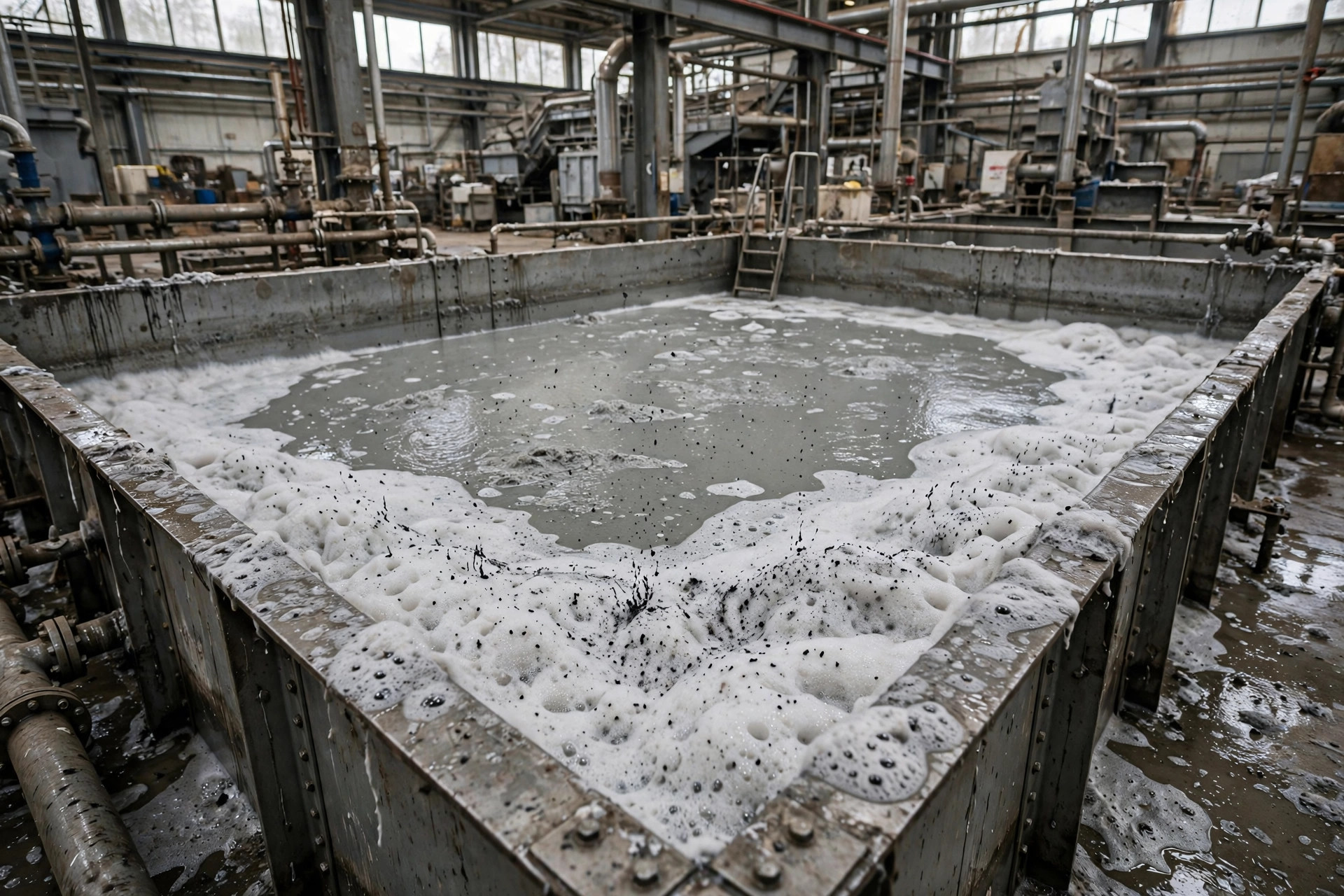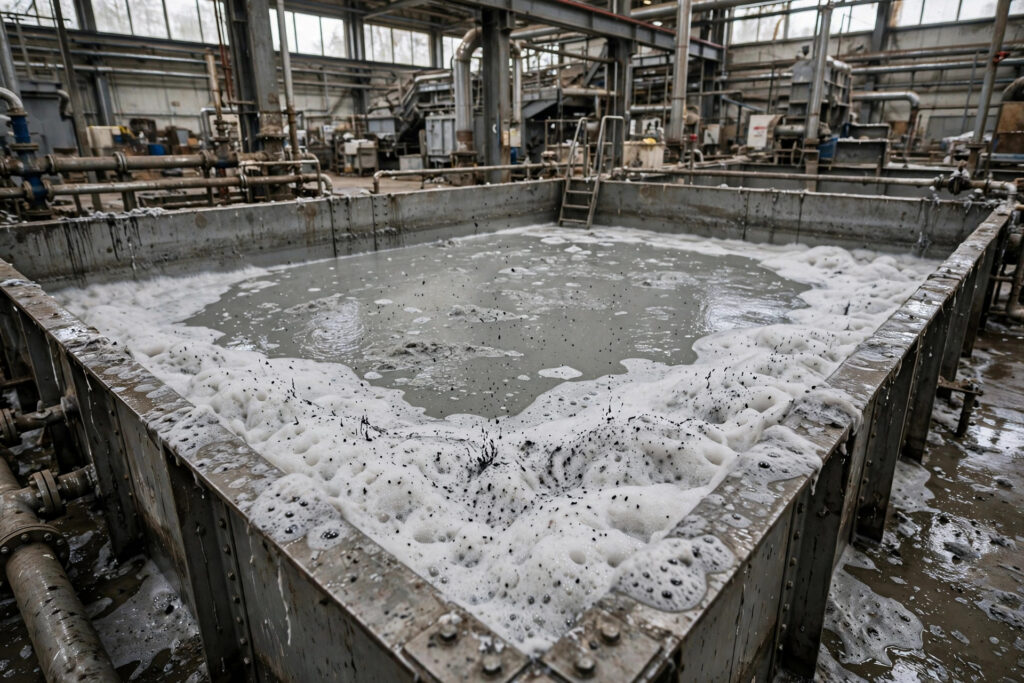
Deinking is how printed ink gets stripped off recycled paper so the fibres underneath can be used again. Old newspapers, magazines and office paper go into a pulper with water and a few chemicals, the ink is detached from the fibres, and then it’s floated or washed away — leaving clean pulp that can be made into new paper.
Skip that step and you’d get grey, speckled sheets. Ink left in the pulp spreads through it as the paper is remade, so every recycled sheet would carry a ghost of whatever was printed on the last one. Deinking stops that happening — it’s why recycled newsprint looks white instead of the colour of old newspaper.
What Is Deinking?
Put simply, deinking is the industrial process of removing printing ink from the fibres of recycled paper to make deinked pulp — the whole sequence of pulping, cleaning, detaching the ink and carrying it away, not just one machine.
The hard part isn’t dissolving the ink — it’s getting it off the fibre without damaging the fibre. Some inks sit on the surface, others soak in, and toner is fused on with heat, so each type needs a different approach.
The idea is older than you’d think: a method for removing printing ink from recycled paper dates back to 1774. And if you’re wondering what the ink itself is made of, our guide to how ink is made walks through it.
The Deinking Process, Step by Step
It starts before the paper ever touches water. Bales of recovered paper are opened and sorted — office waste, old magazines, old newsprint, board — then the big foreign objects get picked out on the conveyor: wire, plastic, anything that shouldn’t be in a pulper.
Then comes pulping. The paper goes into a pulper — either a batch tub with a high-shear rotor or a long, perforated drum that runs continuously — with water and chemicals. The rotor chops the paper into smaller pieces and the mix becomes a slurry.
The chemicals do the first part of the detaching work: sodium silicate or sodium hydroxide sets the pH, usually between 8.5 and 10.0, hydrogen peroxide bleaches and stops the alkali yellowing the fibres, and a calcium source — hard water, lime or calcium chloride — helps later on. A collector, usually a fatty acid or fatty acid soap, goes in too — you’ll meet it again at flotation.
After pulping, the slurry is cleaned and screened. Centrifugal cleaners spin the slurry so denser material — staples, grit, sand — moves outward and is rejected. Screens catch the bigger contraries, and fine screening takes out the adhesive “stickies” that would otherwise gum up the paper machine. Those stickies come from book bindings, hot-melt adhesives, label glue and laminating tape.
What comes out is a fibre slurry with the ink detached but still mixed in — removing it is the deinking stage itself.
Flotation Deinking: Ink Rides Bubbles to the Surface
Flotation is the workhorse — the most common deinking process in Europe, adapted from the froth flotation used in mining in the 1950s. The idea is simple: make the ink hydrophobic, stick it to air bubbles, and skim the bubbles off the top.
Air is blown into the pulp suspension, usually at 45–55°C, and the collector added earlier grabs both the ink particles and the air bubbles, so the ink rides up to the surface as a thick froth. That froth is skimmed off before the bubbles break — if they break, the ink drops straight back into the pulp. Most plants run a two-stage system with three, four or five flotation cells in series.
Flotation is very good at removing ink particles larger than about 10 micrometres, which covers most conventional offset and flexo print — and because the ink leaves in a concentrated froth, the plant needs no large water treatment setup.
Wash Deinking: When Small Particles Need Rinsing Out
Wash deinking takes the opposite approach: dispersants keep the ink particles separated while the slurry is dewatered — thickened — so the water carries the fine particles away through screens and filters. Belt filters, pressure belt filters, disk filters and static filters do the work.
Washing is at its best on particles smaller than about 30 micrometres — water-based inks, fillers, coating particles, fines and micro stickies — which is why it shows up most often for tissue pulp, and why it’s the more common route in North America for hygienic papers.
The tradeoff is water. Washing uses and discharges far more of it than flotation, so it costs more to treat.
Which Inks Are the Hardest to Remove?
Not all print comes off equally: conventional offset and flexo inks detach readily — that’s what the process was built for — while the trouble starts with inks that form a film on the paper instead of sitting as loose particles.
Toner from photocopiers and laser printers is fused onto the sheet with heat, so it comes off in flat, plastic-like flakes that are too big and too stiff to float well. UV-cured inks are similar: the cured film crosslinks into a tough skin that resists detaching. Our UV offset inks are built for the press, but the cured film they leave behind is genuinely harder to deink than a conventional offset ink.
Liquid toner — the kind used in some digital presses — is another awkward one, and so are water-based flexo inks: their particles are often smaller than 5 micrometres and don’t dissolve well in alkaline conditions, so they slip straight through flotation. The fix there is usually an extra acidic washing stage.
These are the inks researchers keep coming back to: high-intensity ultrasound has been tested to break the films into particles small enough for flotation and washing to handle.
So if a recycler quoted a lower grade for your waste, the ink on it is usually the reason. A sheet printed with standard offset ink is straightforward to deink; one covered in UV-cured film or fused toner is not.
What Deinked Pulp Becomes — and What Deinking Can’t Fix
Once the ink is out, the deinked pulp is thickened, sometimes bleached again, and sent to the paper machine — as newsprint, tissue, writing and printing papers, or the recycled content in packaging board. The exact grade depends on how clean the pulp is and how long the fibres still are.
And here’s the honest limit: deinking cleans fibres, it doesn’t renew them. Every round leaves them shorter and weaker — after four to six cycles they’re usually too short and weak to be useful — so pulp can only be reused so many times before it’s only fit for lower grades. Brightness is the other ceiling: deinked pulp rarely matches virgin fibre for whiteness, which is why recycled printing papers often carry a slightly warmer tone.
None of that makes deinking a minor step. Without it, there is no recycled printing paper at all — just grey pulp. With it, yesterday’s newspaper becomes tomorrow’s.
Flotation Deinking vs Washing Deinking
So which one wins? Neither on its own — they catch different ink: flotation lifts it out on air bubbles, washing rinses it out with water.
What each one removes. Flotation is at its best above about 10 micrometres — most conventional offset and flexo print. Washing is at its best on the fine end, below about 30 micrometres: water-based inks, fillers, coating particles and micro stickies.
Where each one is used. Flotation is the standard route in Europe for graphic papers and newsprint; washing is the more common route in North America, and the usual choice for tissue pulp.
Fibre yield. Flotation keeps more of the original fibre; washing recovers up to around 80% of it.
Water and cost. Flotation’s ink leaves concentrated, so the plant needs no large water treatment setup. Washing uses and discharges far more water, and treating that water costs more.
The honest answer. For high-quality grades like office waste turned back into printing paper, plants usually run both — flotation first for the big particles, washing after for the fine ones.
Frequently Asked Questions
What is deinking in simple terms?
It’s the industrial process of removing printing ink from recycled paper so the fibres can be used again — pulp the paper with water and chemicals, detach the ink, then float or wash it away.
Why is deinking necessary?
Without it, leftover ink would spread through the pulp as the paper is remade, and every recycled sheet would come out grey and speckled. Deinking is what makes recycled printing paper white enough to print on again — and recycling paper instead of making it from virgin fibre is often credited with roughly 35% less water pollution and 74% less air pollution.
Can all paper be deinked?
Most can, but not all of it deinks well. Toner and UV-cured inks form films that resist detaching, water-based flexo inks can be too fine for flotation, and wax coatings and stickies fight the process too. And paper that was never meant to look white, like boxboard, usually skips deinking entirely.
What happens to the ink that’s removed?
It ends up as sludge — the unusable leftover of ink, plastics, filler and short fibres — which mills landfill, burn for energy at the mill, or sometimes pass on as fertiliser for local farms.
How many times can paper be recycled?
Only a few. Fibres get shorter and weaker with every round, and after about four to six cycles they’re too short and weak to be useful. Deinking cleans the fibres; it can’t make them long again.
About Triwill: Triwill Group supplies printing inks, including flexo and gravure inks and UV offset inks, as well as pressroom chemicals for commercial printers. Visit triwillgroup.com to learn more.