Aqueous coating is a clear, water-based finish rolled onto printed paper right on the press. It dries in seconds, stops scuffs and fingerprints, and costs less than almost any other protective finish — and the paper underneath it is usually coated paper, a sheet whose mineral surface is what makes the whole thing work.
That is really two coatings doing two jobs: the paper coating, applied at the mill, decides how ink sits on the sheet; the aqueous coating, applied on the press, decides how the finished piece survives handling, mailing and shelving.
What Is Aqueous Coating?
Aqueous coating — AQ coating, as printers call it — is a clear, fast-drying, water-based overprint varnish. More than half of what is in the can is water. The rest is mostly a polymeric resin, usually acrylic or polyester, plus wax or silicone for rub resistance and surfactants so it flows out evenly.
Think of it like the clear coat on a car’s paint job. The paint underneath is the ink. The clear coat adds the shine, or a sophisticated matte look, and forms a flexible barrier over the top.
It has been the default coating for commercial and packaging printing for around 30 years, largely replacing traditional press varnishes. It dries fast, stays clear instead of yellowing, and carries far fewer volatile organic compounds than the oil-based finishes it replaced. Most AQ-coated paper still goes through standard paper recycling, because the thin polymer layer breaks down during repulping.
One thing it is not: waterproof. Aqueous coating resists light moisture and the odd fingerprint, but it will not hold up to spills or standing water. If a piece genuinely needs a water barrier, that is a job for lamination, or for a barrier coating.
How Does Aqueous Coating Work on the Press?
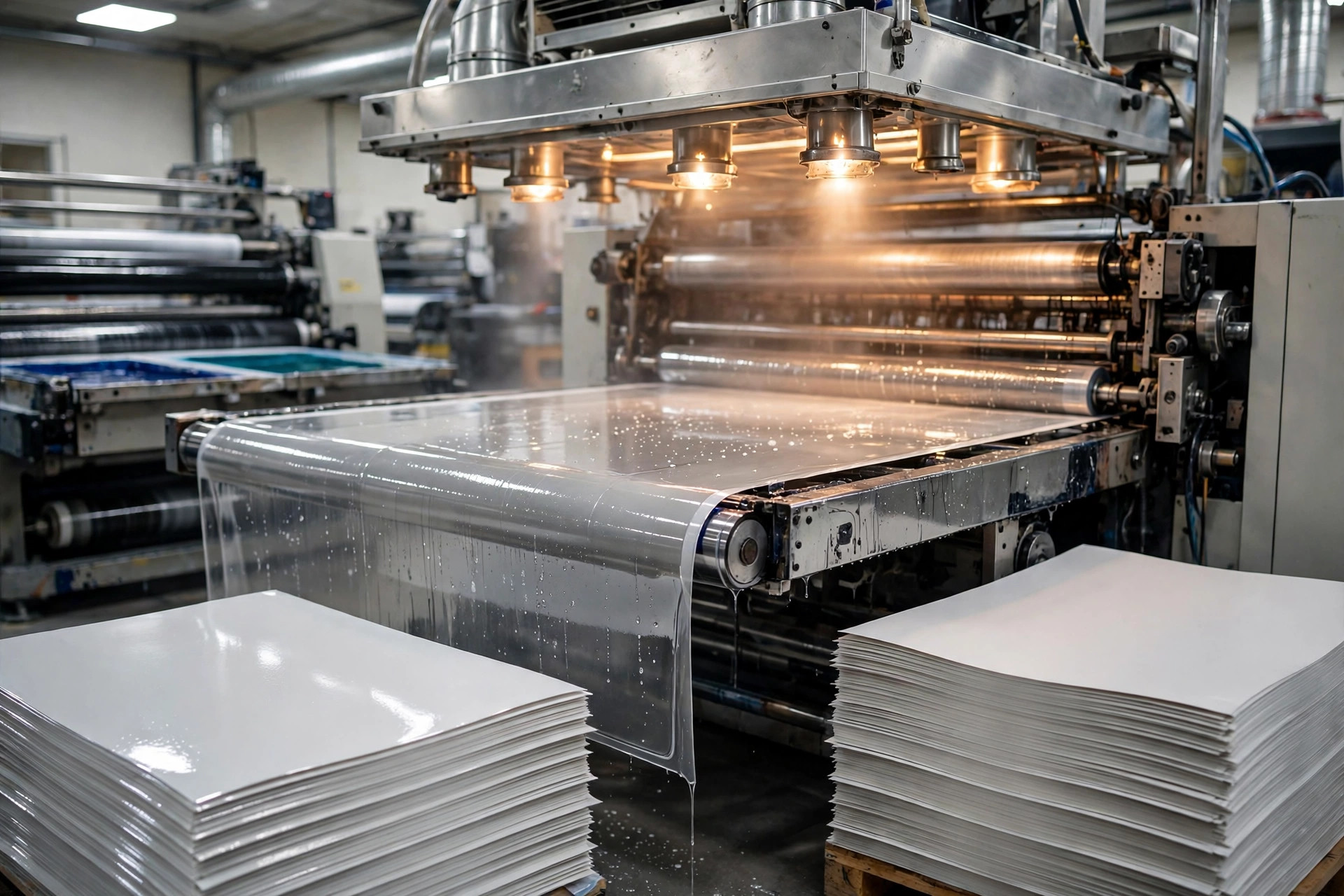
The beauty of AQ is that it never leaves the press. A coating unit — usually a tower coater at the end of the press — lays it down in the same pass as the ink, right after the last colour goes down. Rollers and a blanket transfer a thin, even film across the sheet, almost always as a flood coat.
Then heat and forced air do the rest. The water evaporates, and the resin is left behind as a clear, tough film bonded to the ink and the paper. Drying air typically runs at 60–100°C, helped by infrared lamps and air knives. The whole thing takes seconds, and because the coating goes on while the ink is still damp, it helps the ink set faster.
How much lands on the sheet? A typical dry coat weight is 3–8 g/m² — a thin film, but enough to change how the sheet feels in your hand. Printers watch viscosity closely, measuring it with a #3 Zahn cup: too cold and it goes on too thick and can orange-peel; too warm and it goes on too thin, so gloss and rub resistance drop.
Printers often aim for a load temperature around 95°F (35°C). Much hotter and the coating can soften, so stacked sheets stick together — printers call that blocking. Air flow matters as much as heat, because water evaporates best into low-humidity air.
Paper Coatings: What Makes Coated Paper Different?
Before any ink or AQ touches a sheet, the paper itself may already be coated. Coated paper carries a thin layer of mineral or polymer on its surface, applied at the mill: smoother, brighter, less absorbent. The usual pigments are kaolin clay and calcium carbonate, with bentonite and talc also used, bound to the fibres with binders such as styrene-butadiene latex or starch.
Why does that matter? Uncoated paper is a sponge: ink sinks into the fibres, so colours come out softer and text edges less crisp. A coated surface holds the ink on top, so you get sharper text, richer colour and more consistent results.
Coated papers come in grades. Machine-finished coated paper runs light, at 48–80 g/m², with good print gloss and enough stiffness for magazines. Coated fine paper — the workhorse for offset printing — runs 90–170 g/m² with brightness between 80–96%. Art papers sit at the top: 100–230 g/m², triple coated with 20–40 g/m² per side.
Then there are plastic coatings: paper cups and photographic paper get their water resistance from polyethylene extrusion, silicone or wax — a different problem from AQ.
The practical link: aqueous coating behaves best on coated or matte stocks, because the even surface gives it a consistent base. On uncoated stock, the uneven surface risks mottling — patchy gloss where the coating absorbs differently from one spot to the next.
Gloss, Matte and Satin: Picking the Right Finish
Aqueous coating comes in three main finishes, and each one changes how a piece looks and feels in someone’s hands. Picking the wrong one is the most common mistake in finishing.
Gloss gives prints a bright, reflective surface. Colours pop, photos look vivid, and images seem deeper than they would on uncoated paper. It is the go-to for product catalogues and photo-led brochures. The trade-off is glare, so gloss suits photo-led pages, not text-heavy ones.
Matte does the opposite. It cuts glare, reads as understated and sophisticated, and makes text easier to follow. It also hides fingerprints, a real advantage for folders and sell sheets that get passed around.
Satin sits in the middle, with a soft sheen, rich colour and less glare than gloss. When you cannot decide, satin is the safe pick for mixed pages of photos and text. A fourth option, soft touch, adds a velvety feel for luxury packaging and covers.
So how do you choose? Photos carrying the sale? Gloss. Text carrying the message? Matte. A bit of both? Satin. And if the piece has a reply card or an order form, leave that area uncoated — ballpoint and gel ink skid on aqueous.
Aqueous Coating vs UV Coating vs Lamination: How They Compare
Aqueous is not the only finish on the menu, so how does it stack up? Each one wins somewhere.
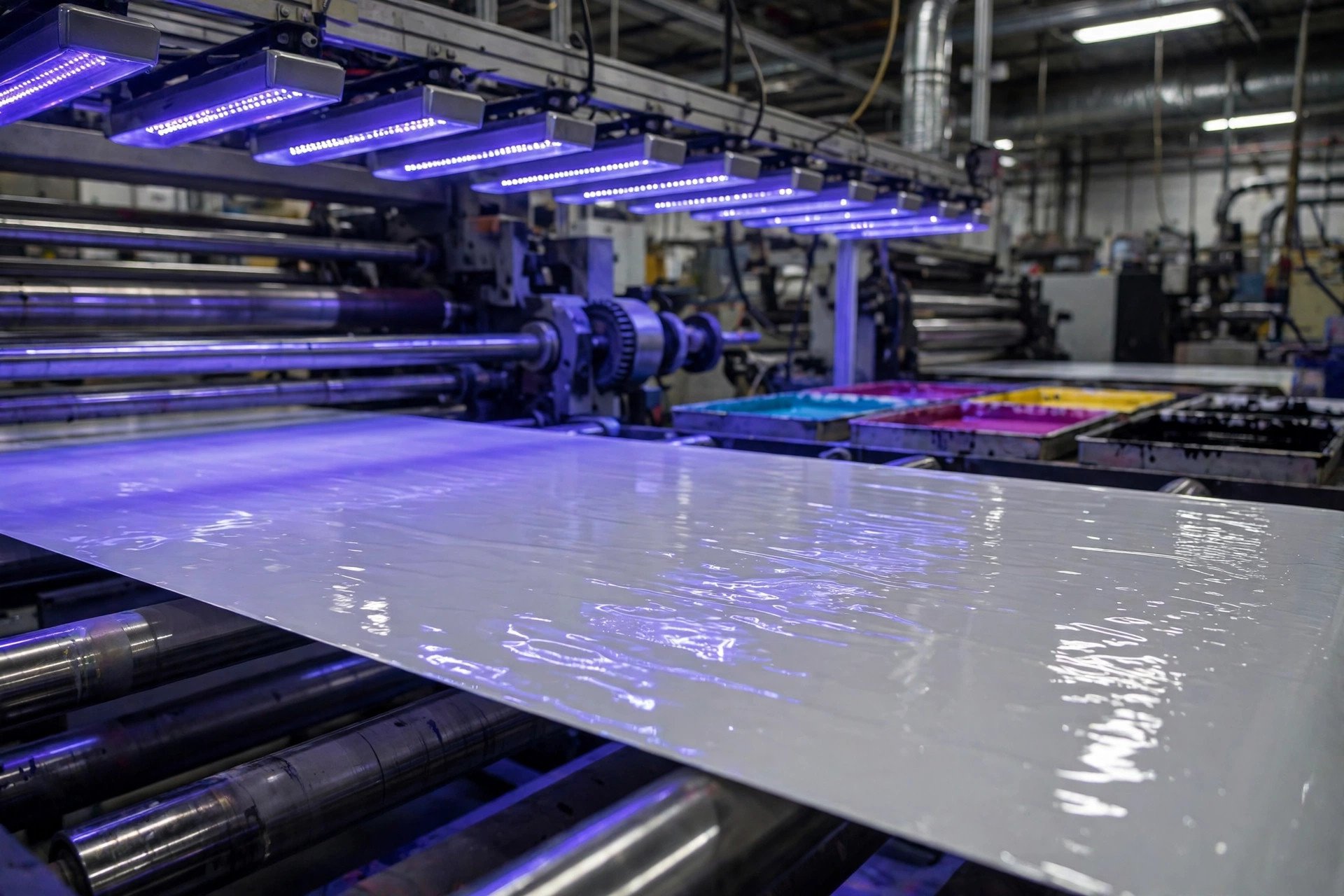
UV coating is the shinier, harder cousin. It is a liquid cured almost instantly under ultraviolet light — we covered how LED UV curing works in our last article — and it lands thicker and glossier than AQ, with the best scratch and chemical resistance of any coating. The trade-offs are cost, a surface that can crack when folded, and a cured layer that resists repulping.
Traditional varnish is the older, oil-based alternative. It dries slower, can yellow over time, and releases more VOCs. It offers less gloss and less protection than AQ, which is why most modern printers use aqueous as their standard instead.
Lamination is not a liquid coating at all. It is a thin plastic film bonded to the sheet with heat and pressure, and it is the most durable option of all: waterproof, tear-resistant, maximum protection. It also adds thickness and a plastic feel, costs the most, and is the hardest to recycle. Use lamination when the product needs to be waterproof and survive heavy, repeated use — a restaurant menu, an ID badge.
Put side by side: aqueous is the lowest cost and the most flexible, with good scuff protection and easy recycling. UV is the glossiest and hardest, at a higher price and with a recycling penalty. Varnish is the budget oil-based option that yellows. Lamination is the toughest and priciest, and the only one that truly resists water.
Where Aqueous Coating Earns Its Keep — and Where It Doesn’t
Brochures and catalogues are the sweet spot, because the inline application keeps costs low on large runs while protecting pieces through mailing and handling. Postcards and direct mail ride through postal sorting machines that scuff unprotected ink, and a coat of aqueous acts like armour so colours arrive as designed. Book and magazine covers shrug off the wear of being picked up, stacked and shelved.
But it is not the right answer for every situation. It is not waterproof, so reach for lamination when you truly need a water barrier. Writing on it is tricky, so leave RSVP lines, order forms and any fill-in area uncoated. And it is subtler than UV — if you want an ultra-high-gloss, almost plastic shine, UV delivers a more intense effect.
A few press-floor details catch people out. Thin paper can warp or curl from the moisture and heat, so AQ works best on stocks of 80lb text or heavier. Glue flaps need a knockout — a small uncoated area — because the wax in AQ can stop cold-set adhesives from sticking. And laser printing is a no: toner will not absorb into most AQ coatings and will flake off.
One last trick: AQ partners well with other finishes. Many aqueous coatings are foil-stampable, so you can add metallic foil on top. And one of the best uses of AQ is as a primer for spot UV — flood a matte aqueous coating over the whole sheet, then apply high-gloss spot UV only on the logo or a photo. The matte-gloss contrast costs far less than a full UV flood.
Frequently Asked Questions
What is aqueous coating?
Aqueous coating is a clear, water-based finish applied inline on the press, right after the ink. It is more than 50% water, dries in seconds, and leaves a thin polymer film that protects print from scuffs and fingerprints.
Is aqueous coating waterproof?
No. Aqueous coating resists light moisture and handling marks, but it will not hold up to spills or prolonged water exposure. It is a scuff barrier, not a water barrier.
Can you write on aqueous coating?
Not easily. Ballpoint and gel ink skid on the coated surface. If a piece has a reply card or an order form, that area must be left uncoated.
What is the difference between aqueous coating and UV coating?
Both are clear protective finishes, but they cure differently. Aqueous is water-based and dries with heat and air; UV is cured under ultraviolet light and lands thicker, shinier and harder. UV gives the highest gloss and the best scratch resistance, but it costs more.
Is aqueous-coated paper recyclable?
Yes. Paper with an aqueous finish still moves through standard paper recycling, because the thin polymer layer breaks down during repulping. AQ is water-based and low in VOCs, and it leaves no plastic film to separate.
What paper works best with aqueous coating?
Coated stocks work best, because their even mineral surface gives the coating a consistent base. Uncoated paper can be coated too, but the uneven surface risks mottling. Use 80lb text or heavier; very thin paper can warp or curl.
About Triwill: Triwill Group supplies water-based coatings, UV coatings and printing inks for commercial printers, including flexo and gravure inks. Visit the Triwill Group home page to explore the full range.