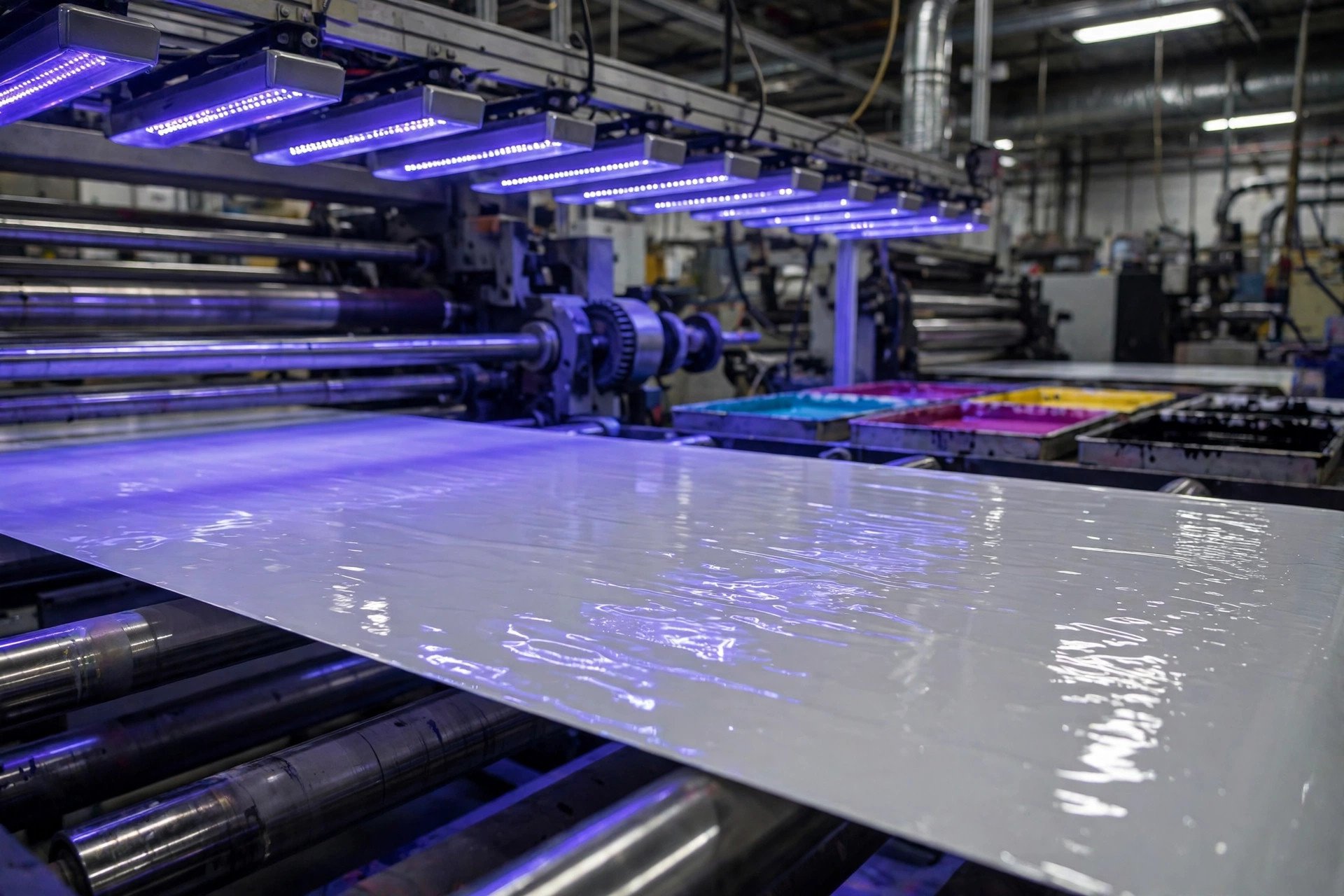
A UV coating is a clear liquid finish rolled over a printed sheet and hardened in seconds under ultraviolet light. The result is that hard, glassy shine you know from premium business cards and book covers — and if the lamps above the press glow violet-blue instead of white-hot, you are looking at LED UV.
The two ideas get mixed up a lot. UV coating is the finish; LED UV is the light that cures it. This article sorts out both: what a UV coating is, how the cure works, and where LED lamps beat the old mercury lamps — and where they do not.
What Is UV Coating?
UV coating is a clear liquid gloss applied over a printed sheet and cured instantly under ultraviolet light. It adds a hard, high-shine layer that deepens colour and resists scuffs and moisture. You can flood the whole sheet — full flood UV — or gloss only a logo or headline, which is spot UV.
So what is UV coated paper, exactly? It means the sheet passed under UV lamps after printing and came out with a sealed, cured shell instead of a wet film. The sheet is dry the moment it leaves the lamp. No drying racks, no waiting, no powder.
That shell does two jobs at once. It makes the print look richer — dark blues and blacks gain real depth under gloss — and it protects the surface from the scuffs, fingerprints and light moisture a piece picks up in a bag, a mailbox or a shop shelf.
But a UV coating is a finish, not a barrier. It protects the print; it does not block oxygen or moisture the way a barrier coating does. That is a different layer with a different job.
How Does UV Curing Work?
The cure is a chemical reaction, not drying. A UV coating is a liquid full of photoinitiators — compounds that sit quiet until UV light hits them. The moment the light arrives, they kick off a chain reaction called photopolymerization, and the liquid crosslinks into a solid polymer film.
How fast? Seconds. The sheet rolls under the lamp, the coating flashes hard, and the job moves straight to cutting and finishing. That is the whole appeal: a conventional varnish needs time and air to dry, and a UV coating needs a few seconds of light.
What the formula cannot see is the shadow. UV curing is line-of-sight — light that cannot reach a spot cannot cure it. A fold, a deep emboss or a thick edge can leave a soft patch, and that is why some jobs use a dual-cure coating that finishes the job with heat or moisture where the light does not reach.
And the coating has to match the lamp. A formulation tuned for one wavelength will not necessarily cure under another — a point that matters a lot once you compare LED with mercury, which is where we are heading next.
What Makes LED UV Different?
A mercury lamp is a glass tube full of vapour. Run electricity through it and it throws out UV across a broad spectrum — UVA, UVB and UVC — plus a lot of heat and some ozone. It has been the workhorse of UV curing in print for over 40 years, and it still is.
An LED UV lamp is a row of semiconductor diodes. It emits a single narrow band of UV — usually around 395 nanometres, with 365, 385 and 405 also in use — and almost no infrared heat. Around 85% of the infrared energy goes out the back of the module, not onto your sheet.
That narrow band is the whole story. Because the energy is focused on one wavelength, an LED system wastes less of it as heat — and the lamps switch on and off instantly, with no warm-up. A mercury lamp needs time to reach full output; an LED is at full power the moment you press the button.
So why has LED not replaced mercury everywhere? Because a coating or ink has to be formulated for that one wavelength. A mercury lamp’s broad spectrum will cure almost any UV chemistry you throw at it. An LED lamp only cures chemistry built for its band — and the UVC part of the mercury spectrum, which helps the surface cure hard, simply is not there in an LED system.
LED UV vs Mercury UV: How They Compare
Side by side, the tradeoff is clear: LED wins on running costs and heat, mercury wins on flexibility. Here is the honest version.
Lamp life. An LED lamp typically lasts 10,000–20,000 hours; a mercury lamp is usually spent after around 1,000. That is the single biggest running-cost difference — fewer lamp changes, less downtime.
Heat on the sheet. LED is a cool light source, so thin films and heat-sensitive stocks stay flat. Mercury lamps run hot enough to warp a plastic sheet or wrinkle a thin film, which is why heat-sensitive work was one of LED’s first wins.
Energy and space. LED modules are small, draw less power and switch off between jobs. On a web offset press, LED modules can replace long hot-air drying ovens entirely — a real floor-space saving as well as an energy one.
Emissions. LED systems use no mercury and produce no ozone. Mercury lamps contain mercury that has to be handled and disposed of, and they generate ozone that must be vented away from the pressroom.
Flexibility. This is where mercury still earns its keep. Its broad spectrum cures a wider range of inks and coatings, including thick or heavily pigmented layers, and lamp doping can shift the output for deeper cures. LED needs matched chemistry — use the wrong ink and the surface stays tacky.
The bottom line? If your work is mostly standard coatings on stable stocks, LED is usually the cheaper, cooler, cleaner choice. If you run a wide mix of substrates and specialty inks in the same pass, mercury’s flexibility is hard to give up — and plenty of presses run both, LED on some units and mercury on others.
Where UV Coating Earns Its Keep — and Where It Does Not
UV coating pays off most on pieces that get handled a lot and have to look sharp: business cards, postcards, presentation folders, catalogue covers and retail packaging. A glossy cover lifts the whole piece, and the cured shell keeps it clean through the mail stream or the shop shelf.
On a flexo press, LED UV is now a familiar sight. Our guide to flexographic printing covers the press itself, and the UV inks that cure under those lamps are explained in our guide to what flexo ink is.
But know the limits before you spec it. You cannot write on a UV-coated surface — a pen skates off it, so forms and appointment cards need an uncoated panel. A heavy fold can crack the hard coating along the score, which is why folded pieces often go to lamination instead.
Fingerprints show, too. A large dark solid under full gloss picks up every smudge, and under bright light the glare can make copy-heavy pages harder to read. And on food packaging, UV inks need their own compliance work — our guide to NIAS and food packaging ink explains what has to be proven before a UV ink goes near food.
How Do You Know a UV Coating Is Properly Cured?
A coating that looks dry is not necessarily cured. Under-curing is the quiet failure in UV work — the sheet feels fine, then the gloss dulls, the surface marks, or ink lifts a week later.
The press-floor check is simple: press your thumb hard on the cured surface and twist. A fully cured coating does not mark or smear; a soft one shows a thumbprint or picks up a faint haze. A strip of adhesive tape pressed on and pulled off tells the same story — if coating or ink comes away with it, the cure was not complete.
What causes it? Usually the wrong match — a coating formulated for a different wavelength, a lamp running below full output, or a press speed that does not give the sheet enough time under the light. Thick, heavily pigmented coatings are the usual suspects, because the light has to fight through the pigment to reach the bottom of the layer.
If the test fails, slow the press, check the lamp output and confirm the coating is rated for your lamp type before you run the job again. Re-running the same setup faster will not fix a mismatch.
Frequently Asked Questions
What is a UV coating?
A UV coating is a clear liquid finish applied over a printed sheet and hardened in seconds under ultraviolet light. It forms a hard, glossy layer that deepens colour and protects the print from scuffs and moisture. It can cover the whole sheet (full flood) or selected areas (spot UV).
What does UV coated mean?
It means the printed piece was finished with a UV coating that was cured under UV lamps, so the surface is sealed and dry the moment it leaves the press. A UV-coated card feels smooth and glassy; an uncoated one feels like plain paper.
Is LED UV better than conventional UV?
For most standard work, yes: LED lamps last far longer, use less energy, run cooler and need no warm-up. But conventional mercury lamps cure a wider range of inks and coatings, so presses running varied or specialty work often keep mercury — or run both.
Is UV coating the same as lamination?
No. UV coating is a thin liquid layer cured with light; lamination bonds a plastic film over the sheet. Lamination is thicker and flexes better on folds, while UV gives a harder, glassier shine at a lower cost per sheet. Aqueous coatings sit in between — a water-based finish with light protection and a softer sheen.
Can you write on UV coated paper?
Not easily. The cured gloss repels most pen ink, so anything people need to fill in by hand — forms, appointment cards, reply panels — should be left uncoated or finished matte on that side.
What is the difference between LED UV and UV?
UV is the curing method; LED UV is one way of producing the light. Conventional UV uses mercury lamps with a broad spectrum; LED UV uses diodes at a single narrow wavelength, usually around 395 nanometres. The coating has to be formulated for whichever lamp cures it.
About Triwill: Triwill Group supplies UV coatings and water-based coatings for commercial printers, as well as printing inks, including UV offset inks and flexo and gravure inks, and pressroom chemicals. Visit triwillgroup.com to learn more.