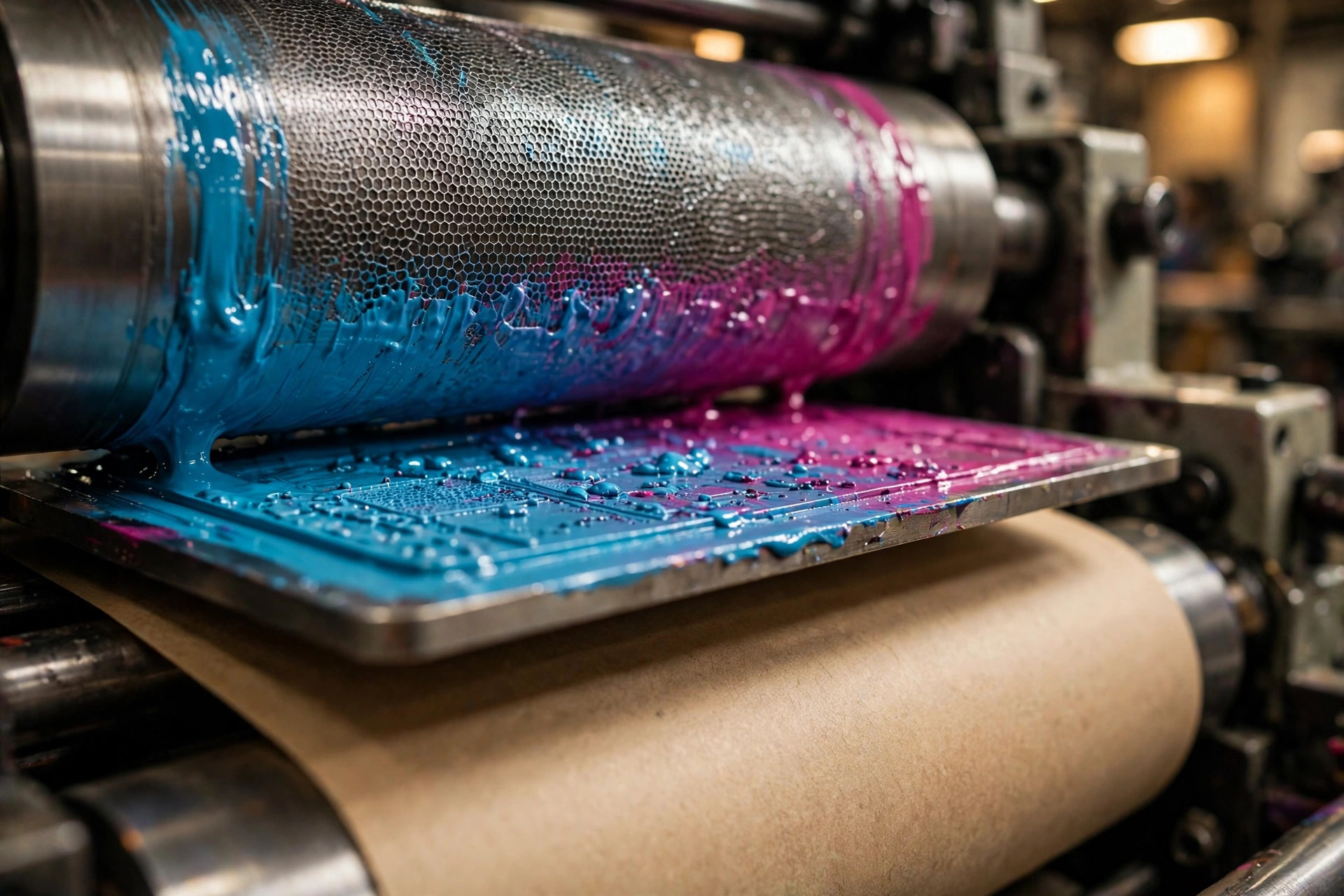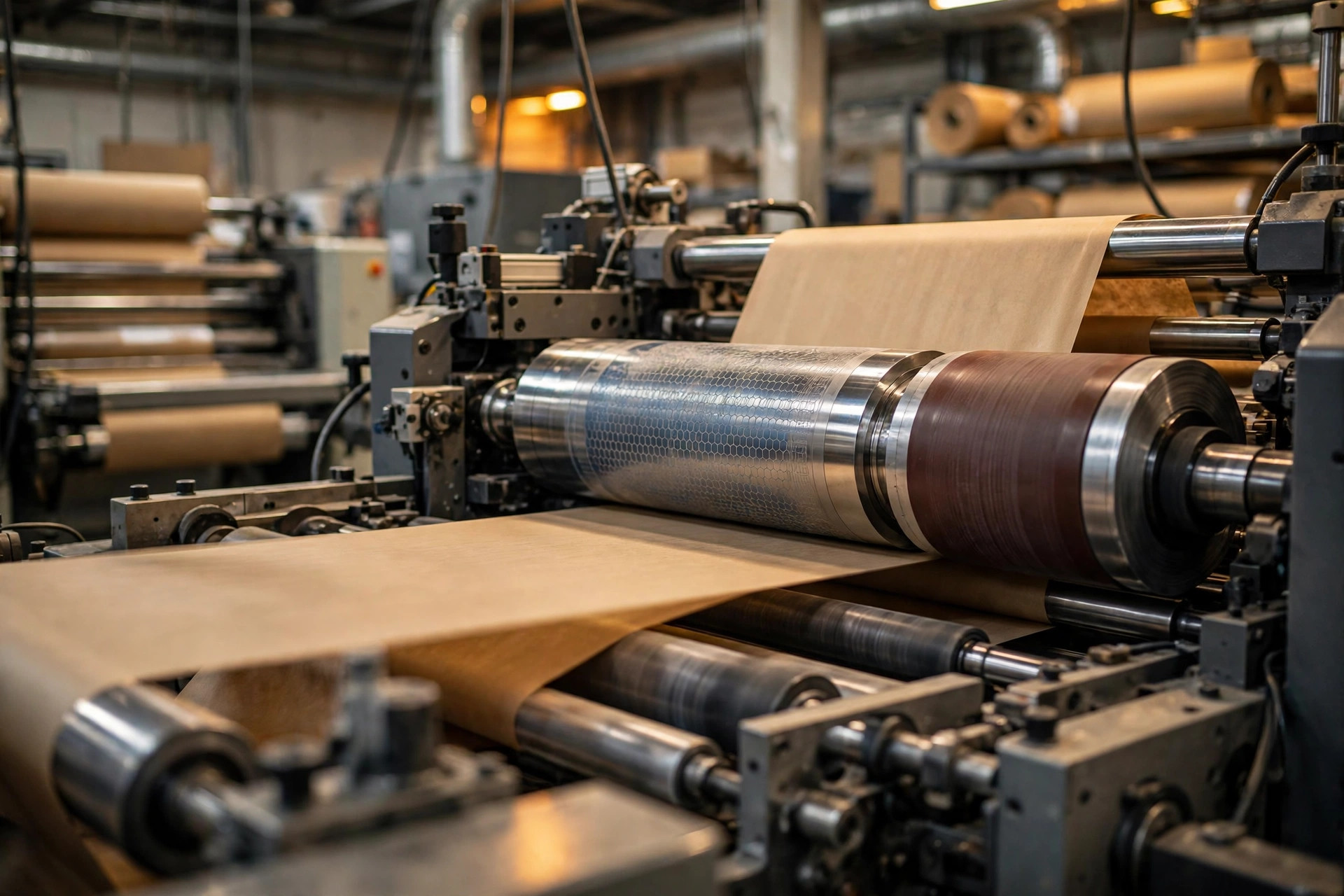
Flexographic printing is a high-speed relief process that stamps ink onto packaging with a flexible plate. A photopolymer plate wraps around a cylinder, picks up a measured film of ink from an engraved anilox roller, and presses it straight onto paper, film, foil or corrugated board as the web races through the press.
If you picked up a cereal box, a shampoo label or a shipping carton today, it was probably printed this way. Flexo is the workhorse behind most packaging on a supermarket shelf — fast, able to handle almost any material, and cheap per unit once the run gets long.
What Is Flexographic Printing?
Flexographic printing — flexo for short — is a direct relief process: the image areas on the plate stand raised above the non-image areas, ink goes onto those raised areas only, and the plate transfers it directly onto the substrate — no rubber blanket in between, unlike offset.
The plate itself is the point. It is photopolymer, a light-sensitive plastic that hardens where UV light hits it, and it bends around a cylinder — so it prints on uneven surfaces that would defeat a rigid plate, corrugated board being the classic example.
Flexo is a modern descendant of letterpress, and older than most people expect: the first press of this type was patented in Liverpool in 1890, and the name “flexography” was picked in 1951 after a poll of the trade journal’s readers.
Early flexo had a reputation for rough quality — simple line work and solid colours. Photopolymer plates, better anilox rollers and tighter press control have changed that: modern flexo holds fine detail, small text, smooth gradients and CMYK process images.
How Does Flexographic Printing Work?
The whole press can be summed up in one line: ink system, anilox roller, printing plate, substrate, impression cylinder — four jobs in that chain at every print station.
First, ink delivery. Ink sits in a chamber or pan at the print station and a fountain roller picks it up — water-based, solvent-based or UV-curable depending on the job, chosen for the substrate and end use.
Second, anilox metering. The fountain roller passes the ink to the anilox roller, a steel or ceramic roller engraved with thousands of microscopic cells that hold a fixed volume of ink. A doctor blade — a thin metal strip — scrapes off the excess so every rotation carries the same measured film.
Third, plate-to-substrate transfer. The anilox rolls ink onto the raised image areas of the plate, and the plate presses it onto the substrate between the plate cylinder and the impression cylinder. Pressure stays relatively light, which is why flexo copes with delicate or uneven materials.
Fourth, drying or curing. Water-based and solvent-based inks dry by evaporation and absorption; UV inks cure instantly under UV light. A multi-colour job passes through one station per colour — cyan, magenta, yellow, black, plus any spot colours — in a single pass.
How much ink does all that use? The anilox meters it tightly, but the exact figure depends on anilox volume, coverage and run length — our guide to how to calculate ink consumption works through the numbers.
The Anilox Roller: The Heart of the Press
Ask a flexo printer what decides print quality and most will point at the anilox before the plate — the plate carries the image, but the anilox decides how much ink reaches it.
Cell volume and cell count are the two numbers that matter. A high count with small cells feeds fine detail and halftones; a low count with big cells lays down heavy solids. Get it wrong and you either starve the image or flood it — too much ink fills in fine detail, too little leaves solids weak and patchy.
That is why changing one part changes the print: swap the anilox and the same plate, ink and substrate give a different result.
So if a flexo print looks wrong, don’t blame the plate first. Check the anilox specification against what the artwork actually needs.
What Can Flexographic Printing Print On?
Substrate range is flexo’s strongest card: the same press family prints kraft paper and paper bags, coated and uncoated paper, corrugated board, labels, tissue and flexible films such as BOPP, PET and PE — plus metallic foils for snack packaging and blister packs.
Paper and film behave very differently on press. Paper absorbs ink, so it sinks in and dries into the fibres. Film doesn’t absorb at all, so the ink has to wet the surface and grip it — corona treatment is sometimes used to help it stick.
Even two papers can disagree: the same CMYK artwork looks different on coated and uncoated stock, because ink stays near the surface of smooth coated paper while absorbent uncoated stock shifts density, contrast and dot appearance. The substrate is part of the printing system — which is why a colour approved on one paper can surprise you on another. For colour-critical packaging, proof on the actual production stock.
Corrugated board is one of flexo’s biggest applications, and direct printing on it needs care with plate pressure, ink, anilox choice and registration, because board surfaces vary in smoothness and absorbency. Done right, the graphics go straight onto the carton — no separate litho sheet printed and mounted on top.
Which Inks Does Flexo Use?
There is no single “flexo ink”: three families of flexo ink cover nearly all flexo work, each matched to a substrate and an end use. Pick the wrong one and the ink simply won’t bond.
Water-based inks are the go-to for paper, paperboard and corrugated board. They dry through absorption and evaporation, carry low odour, and are a common choice for food packaging. Our guide to how ink is made walks through what goes into one — pigments, resins and milling.
Solvent-based inks are built for non-porous films and foils, where they grip slick surfaces, dry fast and resist scratches and moisture. The flexo and gravure inks on pouches and wrappers are usually solvent-based or water-based depending on the construction.
UV-curable inks cure instantly under UV light and leave a durable, high-gloss finish — a natural fit for premium labels. They need UV curing equipment, and pair well with UV coatings when a job needs extra protection or gloss.
Food and beverage work adds its own rules: only certain inks may sit near food, and compliance is judged on the finished pack, not the ink alone. Our article on NIAS and food packaging ink explains what that means.
Flexographic Printing vs Offset, Gravure & Digital
Flexo only makes sense next to the alternatives. Each process wins somewhere and loses somewhere else.
Offset lithography prints superb images on paper and is the standard for brochures and commercial print — but it cannot run plastic film or corrugated board. Flexo can, which is why packaging leans on it, though offset still wins on fine photographic detail.
Gravure produces arguably the finest packaging images of all — but engraved metal cylinders cost a great deal to make, so gravure only pays off across very long runs, millions of impressions. Flexo delivers strong quality at a fraction of the plate cost.
Digital needs no plates at all, so it wins on short runs, samples and variable data — every copy can be different. But once the run passes a few thousand units, flexo pulls ahead on speed and cost per piece.
Put together, the trade is simple: flexo gives up a little top-end image finesse for range and speed. If your job is packaging on film, foil or board at volume, that trade is usually worth making.
When Flexo Is the Wrong Choice
Flexo is not the answer to every print job, and the limits are worth stating plainly.
Short runs are the first one. Plates, setup and colour matching take time and money before the first good sheet comes off the press, so for a few hundred or a couple of thousand units a digital press usually wins — the crossover sits around a few thousand, and it moves with the job.
Very fine detail is the second. When ink transfers from a soft plate under pressure, dots spread slightly — printers call it dot gain — so highlights can fill in and shadows can plug. Prepress teams shrink the dots in the file to compensate, but there are limits: reverse text below about six point and hairlines under half a point can fall apart on press. Ask your printer for their dot gain curves before you separate the art.
Variable data is the third. Flexo prints the same image every rotation; if every label needs a different name, code or image, that job belongs on a digital press.
None of that makes flexo a weak process. It makes it a specialised one — built for volume packaging, not for one-offs.
Frequently Asked Questions
What is flexographic printing used for?
Mostly packaging: labels, flexible packaging, corrugated boxes, paper bags, wrappers and tissue, plus food and beverage packaging, where flexo’s film and foil capability matters most.
How is flexographic printing different from offset printing?
Flexo is direct relief: the flexible plate touches the substrate and transfers the ink itself. Offset is indirect — the plate transfers the image to a rubber blanket, and the blanket prints the paper. That is why flexo prints film, foil and board while offset stays largely with paper.
What is an anilox roller?
The anilox is the roller that meters the ink: its surface is engraved with microscopic cells that hold a fixed volume of ink, and a doctor blade scrapes off the excess so every rotation lays down the same film. That is why printers call it the heart of the press.
Can flexographic printing print in full colour?
Yes. Modern flexo reproduces CMYK process images as well as spot colours, each colour from its own plate on its own station. Quality depends on substrate, plate, anilox, registration and artwork — so “flexo can print CMYK” doesn’t mean every flexo press matches the next.
Is flexographic printing good for short runs?
Usually not. Plates and makeready cost time and money before printing starts, so the cost per unit only becomes attractive once the run gets long — typically several thousand units and up. For short runs, samples or personalised work, digital is the better call.
What materials can be flexo printed?
Kraft paper, coated and uncoated paper, corrugated board, BOPP, PET and PE films, metallic foils, labels and tissue. The flexible plate conforms to uneven surfaces, which is why flexo handles a range no other single process matches at production speed.
About Triwill: Triwill Group supplies printing inks, including flexo and gravure inks and UV offset inks, as well as pressroom chemicals for commercial printers. Visit triwillgroup.com to learn more.