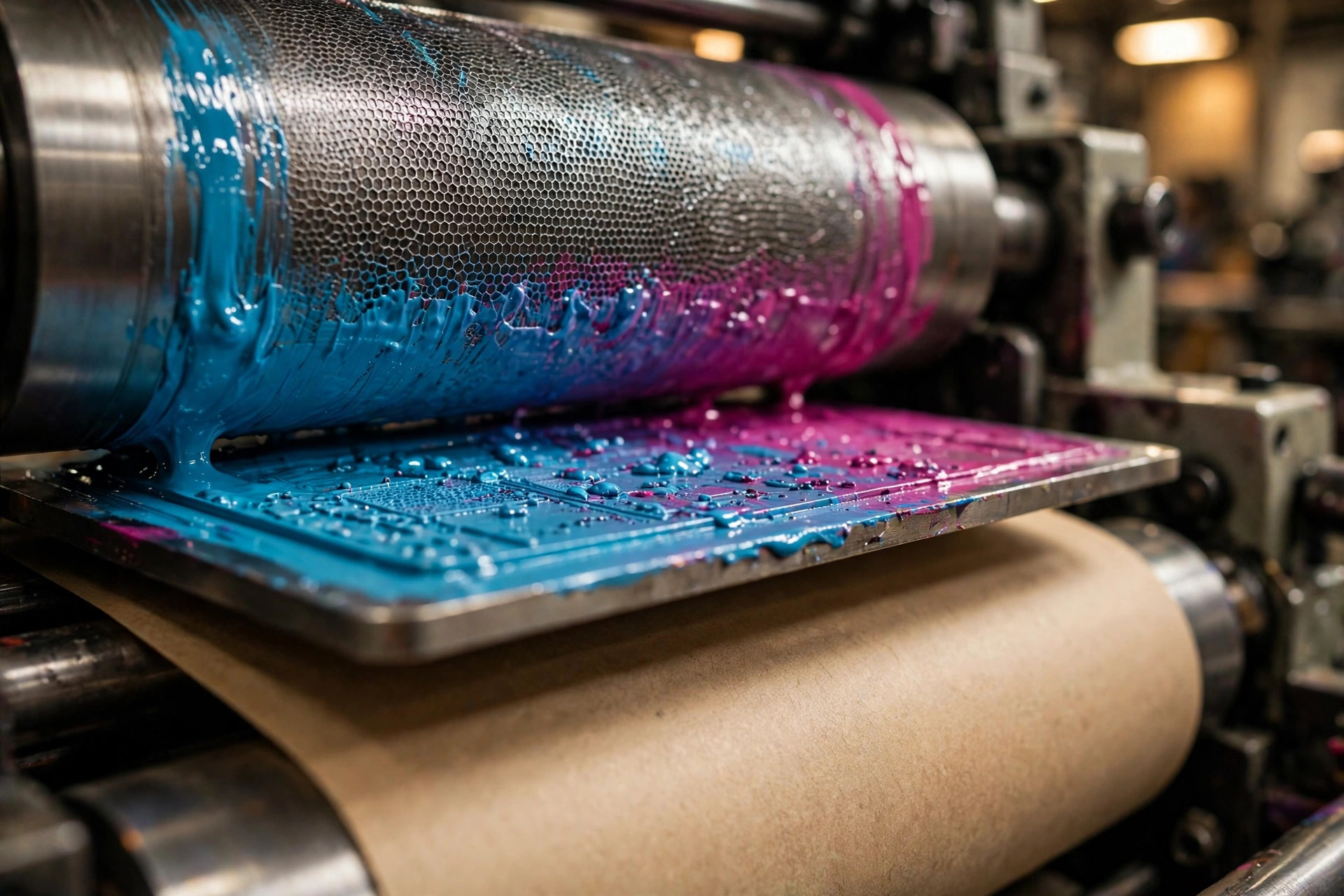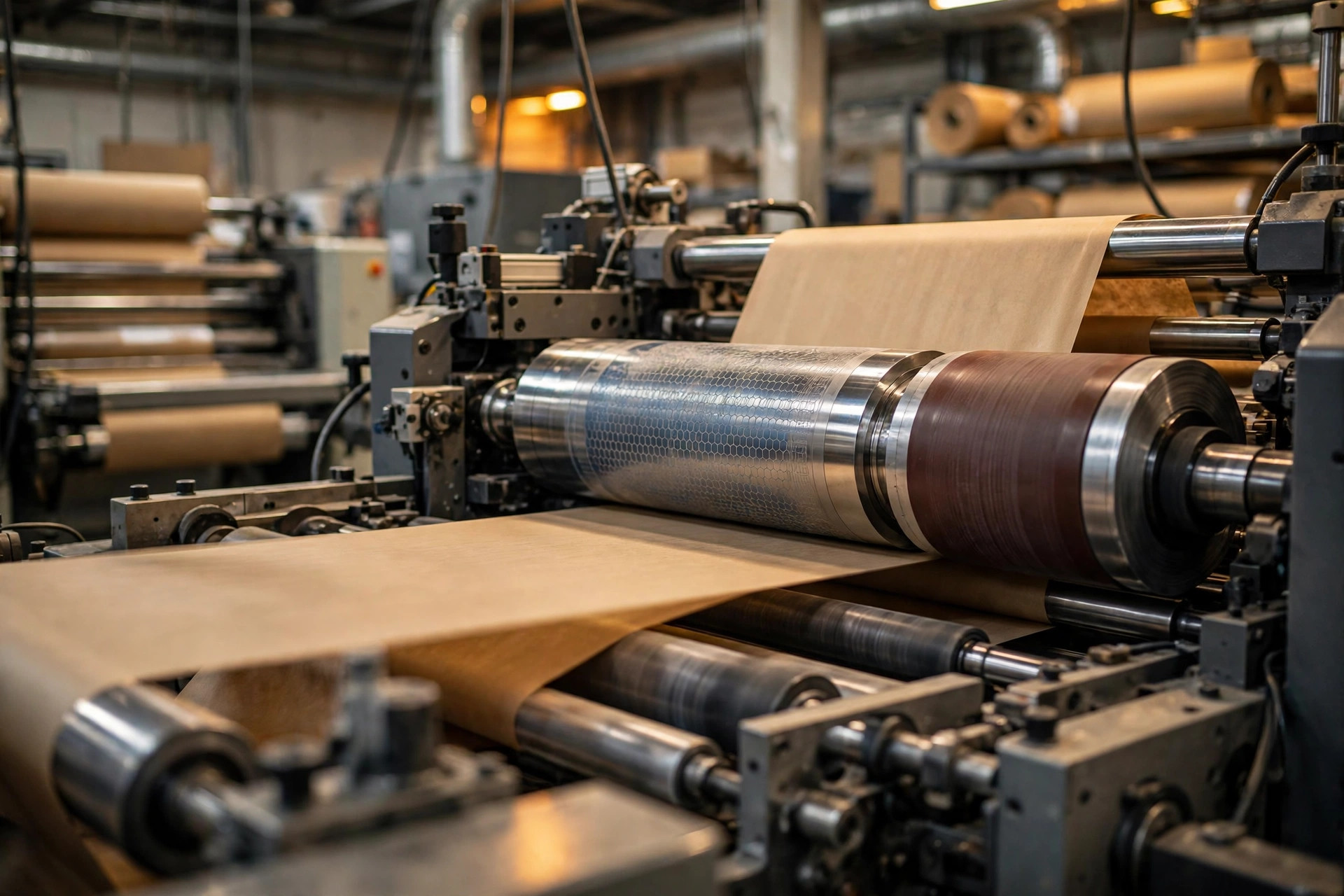
Flexo ink is the fast-drying ink made for flexographic printing — the process behind most packaging on a supermarket shelf. It is a thin, fluid ink built to flow through the tiny cells of an anilox roller, transfer off a flexible photopolymer plate, and dry or cure in seconds.
Pick up a crisp packet or a cardboard box and the print you see came from it. But flexo ink is not one formula: it is three families — water-based, solvent-based and UV-curable — and the wrong one ruins a job fast.
What Is Flexo Ink?
Flexo ink is a low-viscosity ink designed for the flexo process. It has to flow out of the anilox cells, wet the raised image areas of a soft plate, and stick to paper, film or foil — then dry before the web reaches the next station, which is why flexo inks are thinner than offset’s paste inks: more like milk than honey.
The thinness is the point. A flexo press can run at hundreds of metres a minute, and at that speed there is no time for a thick ink to level out or dry. The ink film is only a few microns thick, so it must dry or cure almost instantly — or it smears, sets off onto the next layer of the roll, or dries inside the anilox cells and blocks them.
What’s Inside a Flexo Ink? The Formulation
Every flexo ink is built from four blocks: colourant, resin, liquid carrier, and additives. The colourant gives the colour. The resin — the vehicle — carries the pigment and glues it to the substrate once the liquid is gone. The carrier evaporates or cures away. Additives — wax, defoamer, wetting agent, slip aid — stop foaming, help spreading, and prevent scuffing. Our guide to how ink is made covers these in detail.
The families part company on the carrier and resin: all three carry a colourant in a resin, plus surfactants and additives — what differs is what dissolves the resin and how the ink turns solid. In a water-based ink the resin is usually acrylic, made soluble with an amine and thinned with water. That is why pH matters: if it drifts, viscosity climbs and ink starts drying in the anilox cells.
In a solvent-based ink the resin is dissolved in a solvent blend, typically alcohols with a share of acetates, a common starting ratio being 80–90% alcohols to 10–20% acetates. The solvent is also the diluent: add more and the ink thins; let it evaporate and it thickens. In a UV ink there is no solvent at all: the carrier is oligomers and monomers plus a photoinitiator, and under the lamp the film crosslinks solid in a fraction of a second. LED UV inks work the same way, with photoinitiators tuned to LED lamps.
The Three Main Types of Flexo Ink
Ask a converter which flexo ink they run and the answer is almost always one of three: water-based, solvent-based, or energy-curable — UV, LED and electron beam.
Water-based ink is the workhorse of paper. It dries by evaporation and absorption, carries low odour, and suits paper packaging, corrugated board, paper bags and many narrow-web labels. It has the highest surface tension of the three families, so it beads on slick surfaces — but on absorbent paper it is hard to beat.
Solvent-based ink is built for film. BOPP, PET and PE films don’t absorb anything, so the ink must grip a slick surface, dry fast and resist scratches and moisture. They are the standard for wide-web film packaging, overwraps, pouches and plastic bags, drying in conventional ovens at high speeds. The tradeoff is the solvent itself: it evaporates into the pressroom, so extraction is part of the job.
UV and LED inks cure instead of drying: under UV light the photoinitiator turns the film solid almost instantly — no heat, no waiting. The result is a hard, glossy, scratch-resistant print, which is why UV dominates narrow-web labels. UV inks are the thickest of the three, so they need an anilox with the right cell volume. Electron beam curing works the same way without a photoinitiator, but it is used far less.
How Flexo Ink Works on Press
Flexo ink earns its keep in four steps: ink system, anilox roller, printing plate, substrate. Our guide to flexographic printing covers the press itself.
It starts in the chamber or ink pan, where a fountain roller picks the ink up and passes it to the anilox roller — steel or ceramic, engraved with thousands of microscopic cells holding a fixed volume of ink. A doctor blade scrapes off the excess, so every rotation carries the same measured film. Too much and fine detail floods; too little and solids go patchy.
From the anilox, the ink moves onto the raised image areas of the photopolymer plate, and the plate presses it onto the substrate. Then it dries or cures — evaporation and absorption for water- and solvent-based inks, instant cure under the lamp for UV. Each colour has its own station, so the first must be dry before the web reaches the second, or the colours trap wet and turn muddy.
Two numbers run the show: viscosity and surface tension. Viscosity is the ink’s thickness — how easily it flows out of the anilox cells and off the plate. Too thick and it won’t transfer; too thin and it floods detail. It drifts through a shift as solvent evaporates, so printers measure it and adjust with diluent.
Surface tension decides whether the ink wets the substrate at all. Inks flow towards the higher dyne level, so the ladder runs: ink lowest, plate higher, substrate highest. Get it right and the ink transfers fully; get it wrong and it beads and skips — and no extra pressure fixes it. Ink choice is also plate choice: acetates, heptane or naphtha can swell, shrink, crack or soften photopolymer plates, and a 2020 study measured plates swelling up to 5.7% in methoxypropanol. Check the plate supplier’s compatibility and build the dot gain curve for that ink and condition — a curve built for one ink system does not transfer to another.
Flexo Ink vs Offset Ink: How They Compare
Flexo ink and offset ink do the same job, but they are built for different machines — and you can’t swap them.
First, thickness. Flexo ink is a thin liquid, close to milk, because it must flow through anilox cells and transfer from a soft plate at high speed. Offset ink is a stiff paste, closer to butter, rolled out on a train of rollers and transferred through a rubber blanket. Offset paste in a flexo chamber won’t meter; flexo ink on an offset press floods the rollers.
Second, drying. Flexo ink dries or cures in seconds — evaporation, absorption or UV cure — because the next colour station is a metre away. Offset ink dries by absorption and oxidation over hours, so fresh sheets need time before handling. The tradeoff: flexo’s instant drying enables the speed, but the ink must be right before the run starts, with little room to adjust mid-job.
Third, what each one prints on. Flexo ink covers the widest substrate range in print — paper, board, film, foil, tissue — because plate and ink are chosen together for the material. Offset ink is a paper ink first; superb on paper, but it can’t run film or corrugated board. Offset still wins on fine detail: its paste inks and blanket give finer control of dot shape, while flexo’s soft plate spreads dots slightly under pressure — dot gain. Packaging at volume points to flexo; fine commercial print on paper points to offset.
How to Choose the Right Flexo Ink
Choosing a flexo ink starts with the substrate, not the catalogue: paper, board, film and foil each need a different chemistry, and the wrong match shows up at once.
If the substrate absorbs, water-based is usually the first answer: paper, paperboard and corrugated drink the carrier in, so it dries fast and runs clean. If it doesn’t absorb — BOPP, PET, PE films and foils — the choice narrows to solvent-based or UV, which grip slick surfaces and dry on them. Some water-based formulas work on film with the right treatment, but solvent or UV is the safer default — the flexo and gravure inks on pouches and wrappers are usually one of the two.
End use is the second question: fridge, freezer, steriliser, rough handling, moisture? Solvent inks resist scratches and moisture; UV adds hardness and gloss; water-based suits dry, low-abuse packs. Food packaging adds its own rules: no ink type is food-safe by name. EuPIA no longer even uses “low migration ink” — compliance depends on formulation, substrate, curing and the finished pack, judged on the pack, not the ink. Our article on NIAS and food packaging ink explains what that means.
Frequently Asked Questions
What are the main types of flexo ink?
Three: water-based, solvent-based and energy-curable (UV, LED and electron beam). Water- and solvent-based inks dry by evaporation or absorption; energy-curable inks cure into a solid film under UV light or an electron beam.
Which flexo ink is used for what?
Water-based for paper packaging, corrugated board, bags and narrow-web labels. Solvent-based for wide-web film packaging, overwraps and pouches. UV and LED for narrow-web labels; electron beam much less.
What is flexo ink made of?
A colourant, a resin, a liquid carrier and additives. Water-based inks use an acrylic resin made soluble with an amine and thinned with water; solvent-based inks use a resin dissolved in a solvent blend; UV inks use oligomers and monomers with a photoinitiator instead of a solvent.
Does the ink type affect the flexo plate?
Yes. Acetates, heptane and naphtha, and aggressive monomers in some UV inks, can swell, soften or crack photopolymer plates. Choose a plate family rated for the ink system, a compatible cleaner, and a dot gain curve built for that ink and condition.
Are UV flexo inks safe for food packaging?
No ink type is food-safe by name. Compliance depends on the formulation, the substrate, the curing and the finished packaging structure, which the converter must verify. EuPIA no longer uses the term “low migration ink”.
Can flexo ink print on plastic film?
Yes — that is one of flexo’s strengths. Solvent-based and UV-curable inks are the usual choices for BOPP, PET and PE films, because they grip slick surfaces and dry or cure on them. Water-based inks can work on some treated films, but solvent or UV is the safer default.
About Triwill: Triwill Group supplies printing inks, including flexo and gravure inks and UV offset inks, as well as pressroom chemicals for commercial printers. Visit triwillgroup.com to learn more.