Glue works in two moves. First it arrives as a liquid and flows into every microscopic dip on the surface, getting its molecules close enough to grip. Then it stops being a liquid — it dries, reacts or cools into a solid — and that grip becomes a bond.
Every glue on the shelf is just a different way of doing those two moves. White school glue loses water. Super glue reacts with moisture in the air. Epoxy mixes two parts that harden together. The chemistry changes; the job does not.
People stuck things together with beeswax and tar thousands of years ago. The first modern adhesive, a phenol formaldehyde glue for plywood, arrived around 1910.
Adhesion and Cohesion: The Two Forces Every Glue Needs
Every glued joint depends on two kinds of sticking. Adhesion is the glue holding onto the surfaces — cardboard, wood, plastic. Cohesion is the glue holding onto itself, so the middle layer does not split apart.
You can tell which one failed by looking at the broken joint. If the glue peels cleanly off one surface, that is an adhesive failure — it never really grabbed. If glue is left on both sides and the break runs through the glue itself, that is a cohesive failure — it grabbed fine but was not strong enough inside.
Tar shows why you need both. It sticks to almost anything — anyone who has worked on a roof knows that — but it pulls apart too easily inside itself. High adhesion, weak cohesion, a poor glue for anything load-bearing.
What Happens at the Molecular Level?
So what actually holds the two surfaces together? Mostly, van der Waals forces — the weak attractions between molecules that have a slightly positive end and a slightly negative end. A water molecule carries its two hydrogen atoms at 104.5°, so one end is weakly positive, the other weakly negative — and opposite ends attract.
The catch is distance. These forces only bite when molecules sit a few angstroms apart — an angstrom is one ten-billionth of a metre. Two dry surfaces pressed together never get that close: even a polished surface is peaks under a microscope, and the pieces only touch at the high points. Everything else is a gap.
That is why glue arrives as a liquid. A liquid flows. It fills the valleys, chases out the air and brings its molecules within range of the whole surface. This spreading is called wetting, and a glue that cannot wet a surface cannot bond to it. Grease is the classic killer: a thin oil film keeps the glue from ever reaching the material underneath.
Wetting also explains the second mechanism, mechanical locking. As the liquid glue flows into the surface’s tiny cracks and pores and then hardens, it locks in place like a key in a lock. Geckos do the same with no glue at all: foot hairs split into branches tipped at 200 nanometres, and a billion tiny tips hold the animal to a ceiling.
Other theories exist — electrostatic charges, diffusing molecule chains, chemical bonds — but researchers treat them as supporting players. Van der Waals forces plus mechanical locking do most of the work. And the honest part: scientists still do not agree on the full picture.
How the Main Glue Types Set
Once the glue has wetted the surface, it has to stop being a liquid — a joint full of liquid slides apart under the smallest load. Every glue family answers the same question — what makes it harden? — in its own way.
White glue (PVA) takes the simplest route. It is tiny polyvinyl acetate beads floating in water. Spread it on paper or wood and the water soaks away or evaporates, leaving a continuous film of flexible plastic. A 50-gram squeeze is roughly half water, so about 25 grams of plastic is all that stays behind to do the holding.
Super glue, or cyanoacrylate, needs almost no drying at all. Moisture on the surface — even the water vapour in the air — triggers its molecules to link into long chains, a process called polymerisation. That is why it sets in seconds, and why it bonds skin so eagerly: your skin is damp.
Polyurethane glue also uses moisture — but does more with it. A little water starts a reaction that makes the glue expand into a foam as it cures, filling small gaps. Handy on uneven wood joints — but use less than you think, because it grows.
Epoxy is the two-part option. Resin in one tube, hardener in the other, and nothing happens until you mix them. Once mixed, they react into a hard, cross-linked solid resisting heat, water and chemicals. The tradeoff is time and mess: measure, mix, then work inside a limited window before it sets.
Hot-melt glue skips chemistry altogether. It is a solid stick — usually ethylene vinyl acetate — that melts in the gun, flows into the joint and sets again as it cools. Fast and clean, but the bond softens again if the joint gets hot, so it suits packaging and crafts, not sun-baked joints.
Glue vs Pressure Sensitive Adhesive: How They Compare
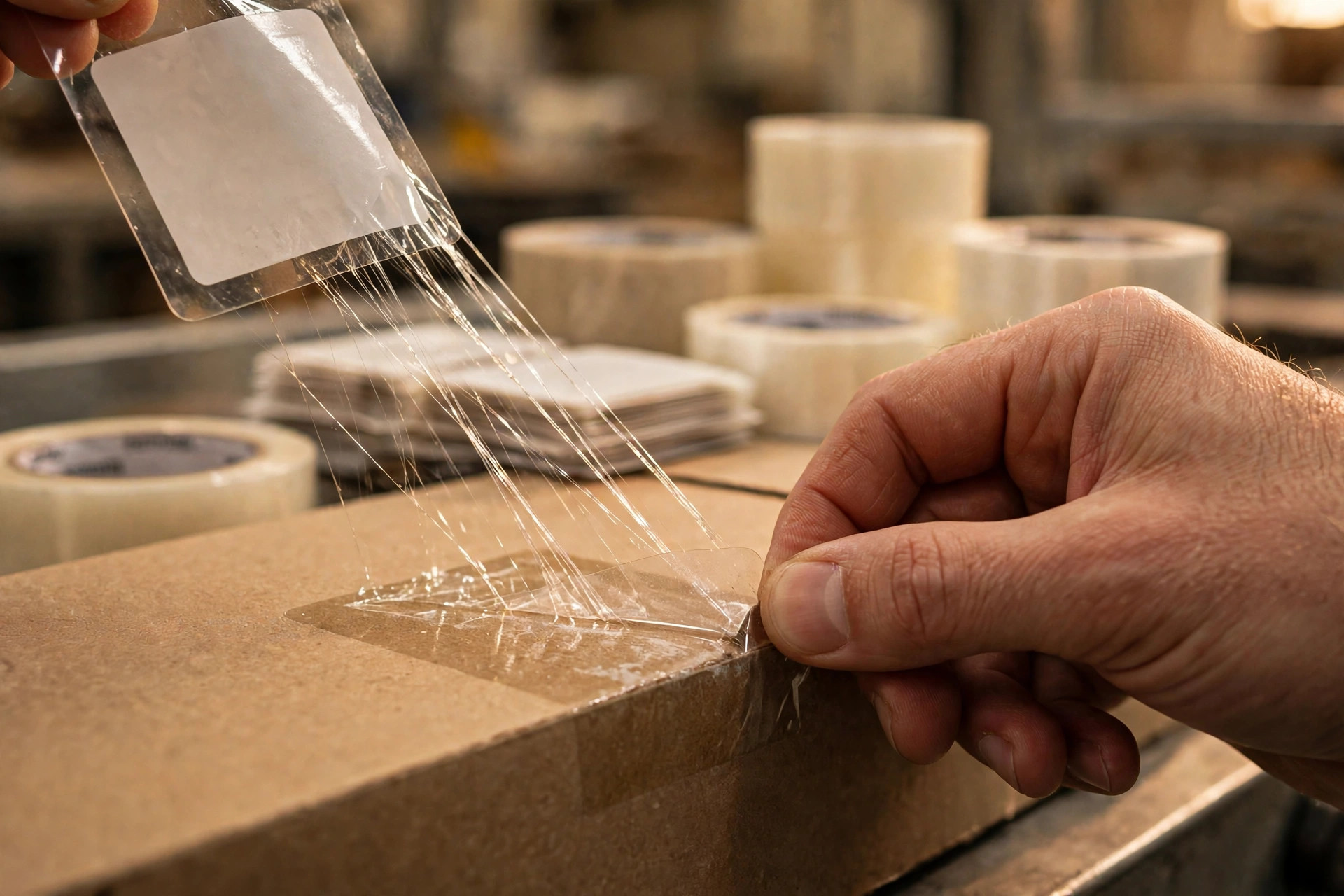
Not every adhesive starts as a liquid. A pressure sensitive adhesive — the sticky stuff on tapes, labels and sticky notes — arrives as a dry, permanently tacky film and bonds the moment you press it on. No drying, no reaction, no waiting. We covered how it works in our guide to pressure sensitive adhesive.
The tradeoff is strength against convenience. A liquid glue flows into the surface, then hardens into a rigid, structural bond that a PSA cannot match. A PSA wins on speed and cleanliness: no clamps, no drying time, no mess. But it stays soft forever, so it creeps under a steady load and will not hold a heavy joint.
Choose by the job. A carton flap on a fast line wants hot melt or PSA tape. A wooden joint that must last a decade wants PVA or polyurethane. A label that must survive a freezer wants a PSA chosen for the cold. Neither family is better in general — only better for one job.
Why Glue Fails — and How to Stop It
Most failed joints are not the glue’s fault. They are the surface’s. Dust, oil, old paint or a fingerprint cuts the contact area, and the glue bonds to dirt instead of material. Clean the surface first — a solvent wipe where the material tolerates it, a dry cloth on paper and board — and you fix the commonest failure before it happens.
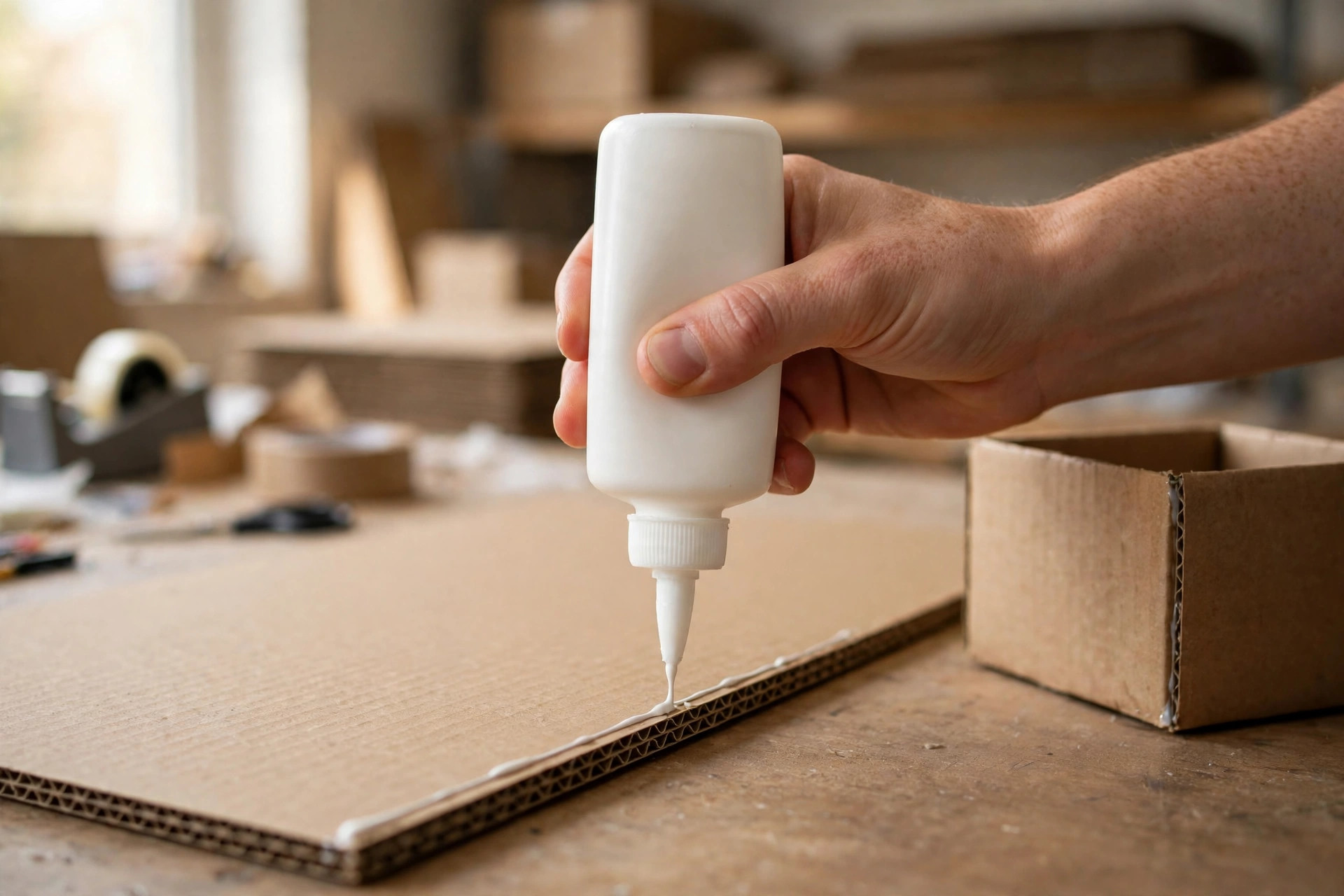
The second mistake is thickness. A thick puddle looks generous, but it takes far longer to set and puts a weak layer in the middle of the joint — the exact place a cohesive failure starts. A thin, even film beats a thick one every time — spread it, press the parts together, and clamp them until it has set.
The third is moving the joint too soon. A glue that feels dry on the outside may still be soft in the middle, and one knock while it cures can break bonds that never reform. Give it the full curing time the maker states, not the handling time. Match the glue to the materials: PVA for paper and wood, cyanoacrylate for small rigid parts, epoxy for heat or water, polyurethane for gaps.
Where Glue Earns Its Keep in Packaging and Print
In packaging, glue is everywhere you do not notice it: carton flaps sealed with hot melt on lines too fast for a drying glue. Labels are stuck with adhesives chosen for surface and temperature. Flexible packaging films are laminated with adhesives that bond film and foil layers without letting anything migrate into the food — the same safety rules that govern food packaging inks.
Bookbinding, folding cartons and corrugated boxes all rely on water-based glues that set as the water leaves: wet the surface, keep the film thin, and let it cure before the box takes a load. Industrial adhesives cover all of these jobs, from carton sealing to lamination — and choosing among them starts with two questions: what are you bonding, and what must the bond survive?
Printing has its own stake in the answer. A label that peels off in the freezer or a carton that pops open in transit is a print job wasted, however good the artwork. The printing plate and the flexo ink matter — but so does the glue underneath. Get the adhesive right and the print stays where it was put.
Frequently Asked Questions
How does glue work at a molecular level? Glue works by getting close: its molecules carry weak positive and negative ends, and within a few angstroms of the surface’s molecules, van der Waals forces pull them together. The glue arrives as a liquid so it can flow into the surface’s microscopic roughness, then hardens so the grip becomes a solid bond — plus mechanical locking for extra strength.
Why doesn’t glue stick to the inside of the bottle? Because the bottle keeps the trigger away. White glue hardens when its water evaporates, and a sealed bottle gives the water nowhere to go. Super glue hardens when it meets moisture, and a sealed tube keeps moisture out. Open the bottle, spread the glue, and the trigger arrives.
What is the strongest type of glue? There is no single strongest glue — it depends on what you are bonding. Epoxies are the usual pick for a hard, structural bond resisting heat and water. Polyurethanes suit wood joints with small gaps. Cyanoacrylates are strong on small, rigid parts but brittle on flexible materials. The strongest joint is where glue, materials and conditions match.
How does super glue work? Super glue is cyanoacrylate, and it sets by polymerisation. Moisture on a surface — even the water vapour in the air — triggers its small molecules to join into long chains within seconds, forming a hard plastic. That is why it bonds skin so fast and suits tight-fitting, rigid parts. It needs so little moisture that a dusty surface can slow it down.
How long does glue take to dry? It depends on the glue. Super glue grabs in seconds; hot melt sets as it cools, in under a minute. White PVA feels dry in about an hour on paper, full strength in up to a day. Epoxy’s working time runs minutes to hours. Handling time is not full curing time — wait for the second before you load the joint.
About Triwill: Triwill Group supplies printing inks, flexo and gravure inks, conventional offset inks, coatings and industrial adhesives to commercial printers. Visit the Triwill Group home page to see the full range.