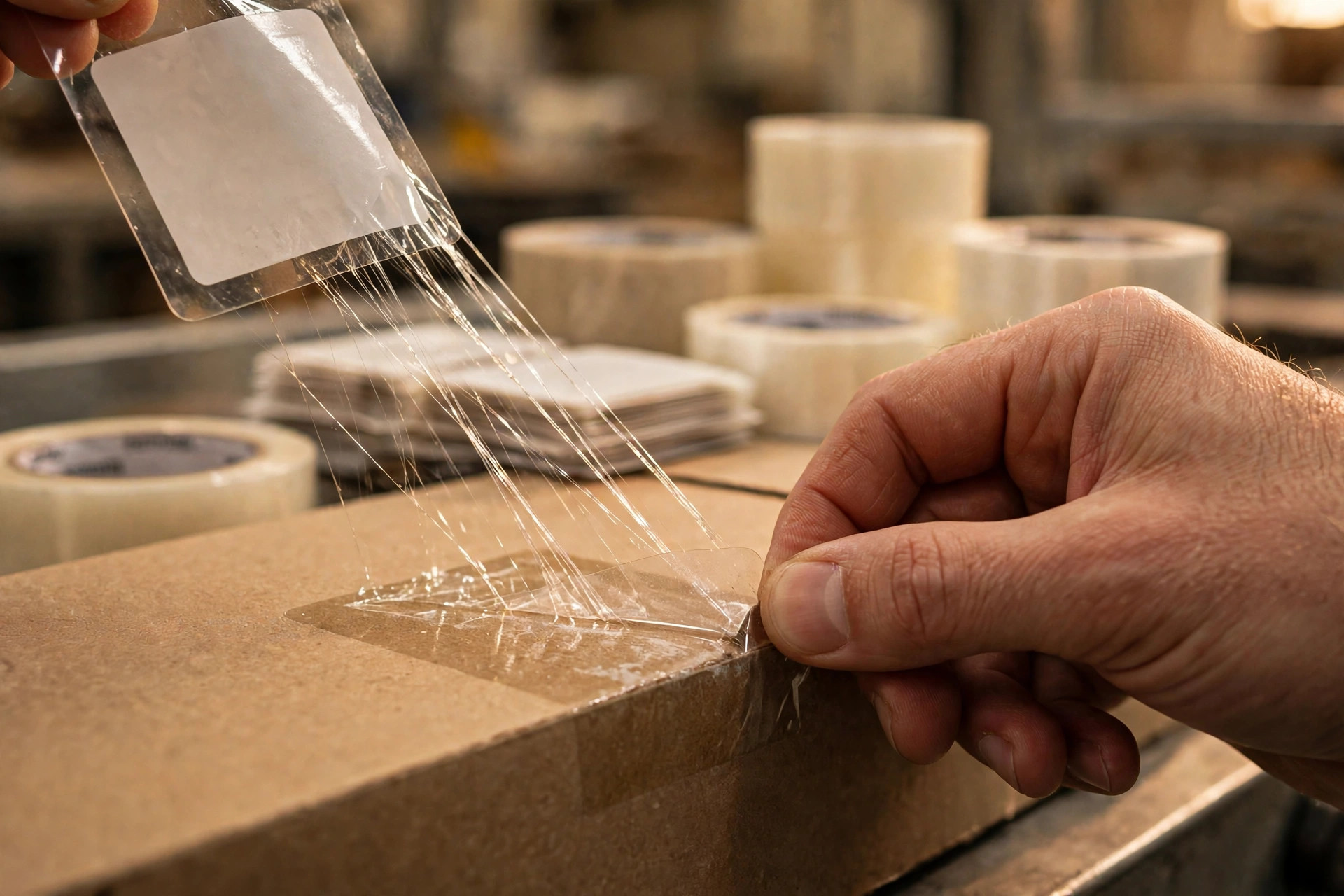
A pressure sensitive adhesive is a sticky adhesive that bonds the moment you press it onto a surface. No heat, no water, no solvent, no waiting for it to dry or cure. Peel a label off its backing, press it onto a box, and it sticks — right away, at room temperature.
You already use pressure sensitive adhesives every day, even if you have never heard the name. They hold the label on your jam jar, the tape sealing the carton, the bandage on your finger and the sticky note on your monitor. The short name is PSA. Grand View Research put the global PSA market at $12.74 billion in 2023.
What Is a Pressure Sensitive Adhesive?
A pressure sensitive adhesive — PSA for short — is a dry, permanently tacky material that holds two surfaces together with nothing more than light pressure. It is not a liquid glue: it arrives as a solid film, already sticky, coated onto a backing or a release liner.
Ordinary glue starts wet, then hardens into a bond. A PSA never hardens, which is why a label can sit on a roll for months and still grab the moment you apply it.
That softness has a limit, though. A PSA has to be soft enough to flow into the tiny bumps and valleys of a surface, yet strong enough inside itself to hold together once it is stuck. Too soft and it slides or leaves residue. Too firm and it never grabs at all.
How Does a Pressure Sensitive Adhesive Work?
So how does a pressure sensitive adhesive actually work? It starts with contact. No surface is truly flat — even smooth-looking glass is full of tiny hills and valleys under a microscope. When you press a PSA onto it, the soft adhesive flows into those valleys. This is called wetting, and it matters because the bond itself comes from van der Waals forces — weak attractions between molecules that only work when two surfaces sit extremely close together. More contact means a stronger hold.
Pressing harder helps: a firm rub pushes the adhesive into more of the surface, and the bond gets stronger. Some permanent PSAs keep building strength for hours or days after you apply them.
There is a rule of thumb behind this, called the Dahlquist criterion: an adhesive only feels tacky if its stiffness sits below about 3 × 10⁵ pascals when pressed for one second. Stiffer than that, and it behaves like a hard rubber band — it touches the surface but never really flows into it.
Once the bond forms, three things decide how well it holds. Tack is the instant grab — how quickly it sticks on first touch. Peel strength is how much force it takes to pull it off. Shear strength is how well it resists sliding sideways under a steady load, like a label hanging on a vertical surface. A good PSA balances all three, and no single formulation wins on all of them at once. What the formula cannot see is your surface: dust, oil or moisture can cut the real contact area in half, and no adhesive can bond to a surface it never touches.
The Four Main Types of Pressure Sensitive Adhesive
Acrylic PSAs. Acrylics are the all-rounders. They bond well to glass, metal and most plastics, resist UV, chemicals and oxidation, and keep working from about −40 °C to 150 °C. They do not yellow, which suits clear labels and outdoor graphics. The tradeoff is cost — they run dearer than rubber — and they can struggle on low-surface-energy plastics like polyolefin film, where the surface itself resists wetting.
Natural rubber PSAs. Made from cis-1,4-polyisoprene, the polymer tapped from the rubber tree, these are the oldest and cheapest PSA family. They grab fast, hold strongly in shear and bend easily around curves — the default for packaging tapes, masking tapes and general-purpose labels. Their weakness is the weather: sunlight, heat and oxygen break them down faster than acrylics or silicones, so they suit indoor, short-life jobs better than outdoor ones.
Synthetic rubber PSAs. Built on styrene block copolymers such as SIS and SBS, blended with tackifiers, these are the workhorses of hot-melt PSAs. They offer aggressive tack and strong peel at a low cost, which is why they dominate disposable hygiene products, labels and carton sealing. Hydrogenated versions such as SEBS trade a little of that tack for better heat and UV resistance, so they survive outdoors longer.
Silicone PSAs. The specialists. A silicone PSA pairs a polydimethylsiloxane polymer with a silicate resin, and keeps bonding from about −60 °C to 200 °C — far wider than any organic PSA. It sticks where others give up, including silicone rubber and fluorinated plastics, and peels off skin cleanly, so it turns up in medical tapes and transdermal patches. It costs the most of the four, and its tack is weak without the right additives.
Permanent, Removable or Repositionable: How Strong Should the Bond Be?
PSAs are also grouped by how hard they are to take off — and this is where most buying mistakes happen. A permanent PSA is built for maximum hold. It cannot be removed without tearing the label or damaging the surface, so it belongs on safety labels and tamper-evident seals. It starts out removable and firms up over hours or days — so do not judge a permanent label five minutes after you stick it down.
A removable PSA is designed the other way. It peels off cleanly, even after months on the surface, without leaving residue behind. Think promotional stickers, masking tape and price labels. Leave one in strong sun for a summer, though, and the adhesive can harden into something far less removable than the name promises.
Then there is the repositionable PSA, the youngest of the three. It uses microspheres — tiny adhesive balls that touch the surface at points, not across the whole area — so you can lift it and stick it again. The first one reached the market in 1968, and the sticky note made it famous. Match the bond to the job’s whole life, not just the first minute: a label that must survive a freezer or a year on a shelf needs a different PSA from one that comes off at the checkout.
Acrylic vs Rubber PSA: How They Compare
Rubber PSAs win on first grab and price. They stick instantly to cardboard, paper and most plastics, cost less, and forgive a dusty surface better than acrylics do. That is why they still own carton sealing tape and everyday labels.
Acrylic PSAs win on staying power. They hold up under UV, heat, chemicals and moisture, do not yellow, and keep bonding where rubber goes soft or brittle. Their bond also builds slowly — an acrylic label can feel weak for the first hour, then hold for years.
Neither, on its own. A rubber PSA on a freezer label fails when the cold stiffens it; an acrylic PSA on cheap carton tape is money spent for durability the job never needs. The right pick follows the surface, the temperature and how long the bond has to last.
Where Pressure Sensitive Adhesives Earn Their Keep — and Where They Don’t
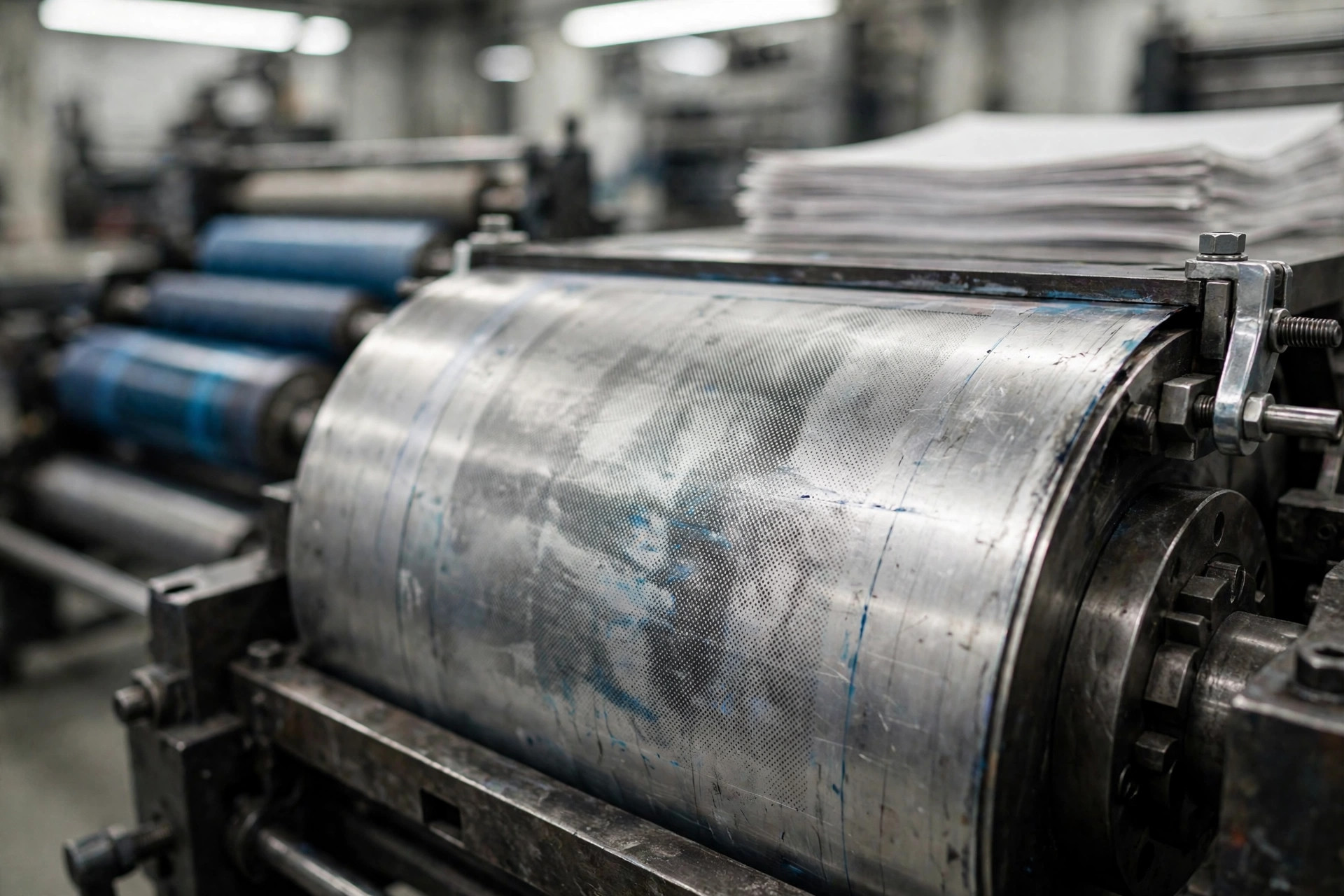
Labels are the biggest use by volume, and the one closest to printing. Most self-adhesive labels are printed flexo or offset before the adhesive ever meets the box — and the printing plate that carries the artwork decides how sharp that print looks. Labels usually run on flexo ink, and food labels have to meet the same safety rules we covered in our guide to NIAS and food packaging ink. A clear UV coating or an aqueous coating often goes over the print to stop scuffs — and it has to suit the adhesive underneath, or the label curls.
Beyond labels, PSAs turn up almost everywhere a fast, clean bond beats a screw or a wet glue. Packaging tapes seal cartons on lines too fast for glue to dry. Carmakers fix trim and emblems with double-sided tape and use it to damp vibration. Electronics assemblers bond screens, batteries and circuits with thin PSA films. Medical tapes hold dressings and sensors on skin. Builders fix vapour barriers and window seals with them.
But a PSA is not a structural adhesive. It will not hold a heavy load in shear for years, bond to a dirty or oily surface, or fix a joint that flexes hard or runs hot. Low-surface-energy plastics — the slippery films used in much flexible packaging — need a silicone PSA or a surface treatment first. If the joint must carry weight, resist weather for a decade or survive an oven, you need a different adhesive family. Choosing a PSA is really about knowing where its limits sit.
Frequently Asked Questions
What does PSA mean? PSA stands for pressure sensitive adhesive. It is an adhesive that bonds when you press it onto a surface, with no heat, water, solvent or curing step.
How does a pressure sensitive adhesive work? It works in two steps. First the soft adhesive flows into the microscopic roughness of the surface when you press it down, creating close molecular contact. Then van der Waals forces hold the two surfaces together, while the adhesive’s own cohesion stops it sliding or splitting apart.
What is the difference between permanent and removable PSA? A permanent PSA is made for maximum hold and cannot be removed without damage; its bond keeps building for hours or days. A removable PSA peels off without residue even after a long time. A repositionable PSA sits below removable: it can be lifted and stuck again many times.
Can you remove pressure sensitive adhesive without leaving residue? Usually, yes — if the PSA was chosen for removal. Peel it back slowly at a low angle and it should come away clean. Residue appears when a permanent PSA is forced off, a removable one has baked in the sun, or the adhesive never matched the surface.
Which pressure sensitive adhesive handles high temperatures best? Silicone PSAs, by a clear margin. They keep bonding from about −60 °C to 200 °C, while good acrylics top out around 150 °C and rubber PSAs much lower.
Do pressure sensitive adhesives stick to every surface? No. They bond best to clean, smooth, high-surface-energy materials such as glass, metal and coated paper. They struggle on low-surface-energy plastics, dusty cardboard, oily metal and wet surfaces, because the adhesive cannot wet what it cannot touch. Cleaning the surface matters more than pressing harder.
About Triwill: Triwill Group supplies printing inks, flexo and gravure inks, conventional offset inks, coatings and industrial adhesives to commercial printers. Visit the Triwill Group home page to see the full range.